to much burpping
Printed From: Tippmann Paintball
Category: Paintball Equipment
Forum Name: Gun Maintenace and Repair
Forum Description: Important info for keeping your marker in top shape
URL: http://www.tippmannsports.com/forum/wwf77a/forum_posts.asp?TID=164287
Printed Date: 29 July 2026 at 2:31pm
Software Version: Web Wiz Forums 12.04 - http://www.webwizforums.com
Topic: to much burpping
Posted By: sparx52
Subject: to much burpping
Date Posted: 08 February 2007 at 11:39am
|
i bought a tippmann 98 custom used it worked fine till one day it was burpping for no reason i check all possible causes didnt see nothing ....I took it to my local proshop and they replaced the rear bolt and sear and it work for a little bit during 1 outing then back to burpping...... i troubleshoot every thing possible so far.....i was wondering if the internal valve could be making it happen,,,,,and is that common that they wear out,,,, |

Replies:
Posted By: Bruce A. Frank
Date Posted: 08 February 2007 at 12:49pm
The power valve just doesn't wear out is a way that could cause the problem you are having. The "burp" as you call it is caused by the rear bolt (hammer) not being blown back far enough to engage the sear. Most people notice it when the gas gets low. There is not enough pressure to blow the bolt full to the rear for sear engagement. The hammer drops again because it wasn't caught by the sear; it hits the pin valve again, but since it wasn't falling from its full rearward position it hits more lightly thus releasing less gas. Usually the bolt recoils less and less further until it comes t rest against the valve pin. You get a short burp of fully automatic fire (though the forward bolt may not be retracting far enough to actually let the next ball move into the receiver). If the "O" ring on the leading edge of the rear bolt is worn too much the blow back gas leaks past it so the full impulse is not of the gas doesn't impart full rearward velocity. The bolt won't travel far enough to engage the sear and the burp cycle begins. The rear bolt could also be galling against the inside of the shells increasing friction. The forward bolt could also have a high friction situation that cases, through the link rod, slower movement of the rear bolt. Keeping these sliding parts, particularly the "O" ring that slides into the rear of the power tube, is essential to keep the "burps" away. It is possible that a bad sear/hammer notch fit can also cause this to happen. The hammer should not be replaced without replacing the sear. If either or both are rounded slightly there can be a failure to engage. Thus begins a fully automatic cycle. The cycle can be so fast then that the gas flow cannot keep up and lower gas flow leads to the "burp"...and eventual stoppage of the bolt. ------------- 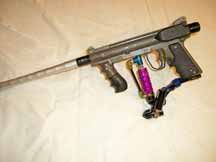 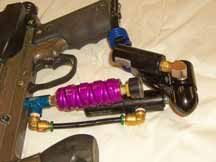
|
 sparx52 wrote:
Posted By: sparx52
Date Posted: 08 February 2007 at 2:58pm
|
i just explain my situtation to a tippmann rep and they said it might be the spring on the sear pin is to weak ( note i have the spring w/out hooks) and is not catching the rear bolt when it blows back... and like i said i all ready just replaced the sear and rear blot(hammer)but not the springs so im going to give them a try but waiting on shipment of springs. also before this situtation started happing i was getting that uncocking problem my gun would shoot fine for a min the un cock??? i wonder if that lead up to the burpping problem. w/ u input??? |
Posted By: TIPPY98ACT
Date Posted: 09 February 2007 at 12:52am
Read the 98 Custom service update in the news section found on the home page. You find what you are looking for. 
|
Posted By: sparx52
Date Posted: 10 February 2007 at 9:26am
| thanks for the info,,, ididnt think one little spring could be the problem im still not convinced yet... that spring looks in very good shape but welll see in a few days..... |
Posted By: nathanours
Date Posted: 10 February 2007 at 1:48pm
|
http://www.tippmann.com/about_us/pressReleaseDetails.aspx?id=26 - http://www.tippmann.com/about_us/pressReleaseDetails.aspx?id =26 try this link it should explain why you are having problems ------------- 
sorry if this offends any one but it is funny Tippman 98c w/ J&J ceramic barrel polished internals expansion chamber |